Subject, Topic, Issue
A framework for AP Seminar students to stop writing broad, boring bullshit
Listen up my fellow Sem teachers. I've only made a handful of posts about teaching AP Seminar, and I've already mentioned subject, topic, issue, more than once but it bears repeating. I reiterated it with my class today while in the media center and my media specialist told me to trademark it. Copyrights be damned, I just want you to teach it!
One of the cardinal sins of AP Seminar is when students take on too broad a topic. I can't tell you how many times I've had to sit through presentations on something like "Poverty" or "Technology." My guy, you're not going to solve "poverty" in 8 minutes.
So, how do we as teachers get our students to understand just how narrow their focus should be? This tool, this simple collection of terminology, has been my silver bullet. I muddled through Seminar for years without it and now I don't know how.
It's this simple:
A subject is something that could contain multiple classes. Think English, Social Studies. If there's a whole college devoted to it at a university, if you can get a degree in it, it's a subject. Sure, no one gets a degree in mental health, but you can get a degree in psychology. Ergo: Mental health = subject. Field or discipline are good synonyms.
A topic is something that might be addressed within a subject. In high school, you might cover the topic of evolution within your biology (subject) class. You could think of topics as units then. (In college, topics might be a whole class, because things get more specialized, but that might not be a helpful way to explain it to your tenth and eleventh graders.) While more specific than a whole subject, it is still not a sufficiently narrow approach for an AP Seminar research question. Students that take on whole subjects and topics must either pivot or founder.
An issue (what we want our students to find and dive into) is what might be covered in a single lesson by a teacher and includes a specific problem or controversy. To use the two previous examples, when a student proposes mental health for their project, I would ask, "How can you make that more specific?" or "Is there a problem within the field of mental health that you're interested it?" "What are the experts in mental health debating?" For evolution, I would say simply, "what's controversial about evolution?" At which point the student might say something about creationism or teaching it in schools and ba-da-boom, we've got an issue.
This kind of questioning and brainstorming makes for a fun lesson. Students name a subject, then the next student narrows it to a topic, and the next to an issue. I teach this early in August, but reviewed it today as they begin PT1. I reminded them how to navigate to the Browse Issues page in the Gale Opposing Viewpoints Database.
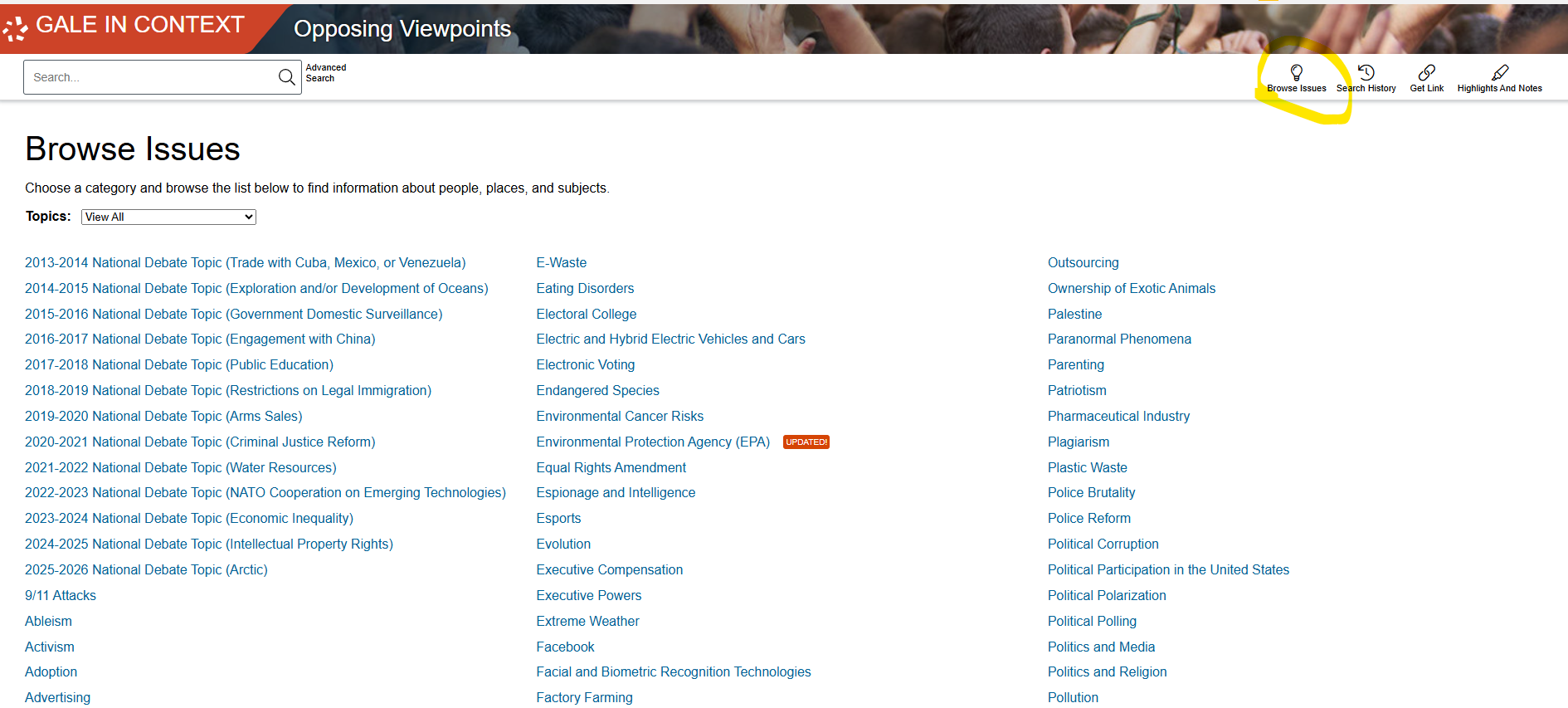
There's 400-something folders of articles on different subject/topics/issues here, but unlike what the title says, they aren't all issues (yet) and kids have to use their brains. So, after reminding them how to get there and putting this screen on the board, I ask them to identify "issues" that are in fact whole subjects. The kids point out that things like E-Sports, Parenting, and Palestine are in fact whole subject areas.
"Great!" I say with all the forced enthusiasm of a fifteen-year high school teacher. "What are some topics?" and the kids wave their hands in the air with the urgency of students who know I grade them on participation. They point to Police Brutality, Environmental Cancer Risks, and E-Waste. I Socratically probe further with my Socratic questions, just as Socrates would have done.
"If E-Waste is a topic, what subject is it in?" (Answer: pollution/climate change)
"How can we make e-waste into a more specific issue?" (Possible answers: legislating against designed obsolesce, cellphone batteries in landfills, etc.)
"Are there any actual issues up there?" I scratch my head like a cartoon character because I was raised by Bugs Bunny. (Answer: maybe something like ownership of exotic animals or the equal rights amendment, but adding terms when a question is written will clarify and provide the additional necessary specificity.)
I have a very rudimentary slide for this in my first curricular week PowerPoint. If you want a handout, a couple worksheets, and even a quiz for teaching this concept, I shall warmly accept your cash here.